




What if the most durable, moisture-resistant, and aesthetically convincing floor in your home wasn't actually made of solid timber? For years, many homeowners have hesitated to choose laminate flooring because they're worried about a plasticky finish or that tell-tale hollow sound when you walk across the room. We understand that concern. Your home deserves a surface that feels as authentic as it looks, without the maintenance headaches or the high price tag of natural wood.
Modern manufacturing has completely transformed this material. It's moved far beyond the budget options of the past to create high-performance surfaces that rival natural timber in both beauty and strength. This expert guide will show you how to select a floor that combines the warmth of honey oak or soft caramel with the resilience needed for a busy British household. We'll demystify technical specifications like AC ratings and the latest 2026 installation standards. You'll gain the clarity you need on thickness, moisture protection, and underfloor heating compatibility to ensure your project is a success from the very first plank.
Key Takeaways
- Master the industry standard for durability by decoding AC ratings to match your floor to the specific foot traffic demands of your home.
- Explore how advanced textures and bevelled edges create a finish indistinguishable from natural timber whilst offering significantly higher resilience.
- Gain confidence in your selection by understanding the moisture-resistant technology that makes modern laminate flooring a practical, stylish solution for kitchens.
- Ensure a flawless, long-lasting finish by following expert guidance on substrate preparation and the essential 48-hour board acclimatisation period.
What is Laminate Flooring? Understanding the Modern Engineered Surface
Laminate flooring is no longer the compromise it once was. Historically, it earned a reputation as a budget-friendly but somewhat artificial alternative to timber. Today, it stands as a sophisticated, multi-layered engineered surface that has become a favourite amongst UK interior designers for its incredible versatility and visual depth. To truly understand what is laminate flooring, you have to look beyond the surface. It's a synthetic product fused together through a high-pressure lamination process, designed to mimic the aesthetic of natural materials whilst offering superior durability.
The Anatomy of a High-Quality Laminate Board
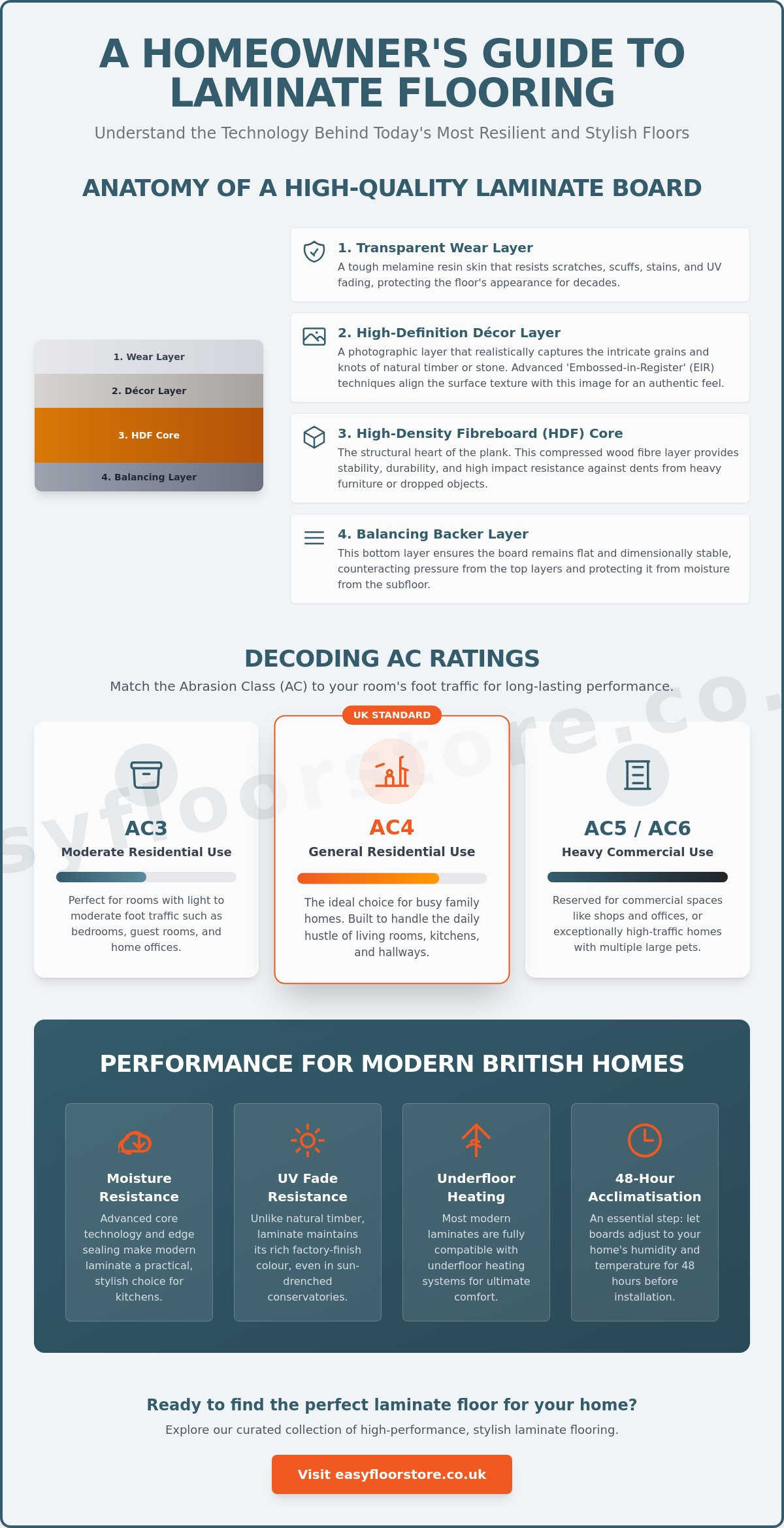
The performance of a board depends entirely on its internal structure. A premium laminate board consists of four distinct layers that work in harmony. At its heart lies the high-density fibreboard (HDF) core. This compressed wood fibre layer provides the structural integrity and impact resistance that prevents the floor from denting under heavy furniture. Beneath this, a balancing backer layer ensures the plank remains flat and stable.
The visual magic happens in the top two layers. A high-definition photographic applique layer captures the intricate grains and knots of authentic oak or stone. This is protected by a transparent melamine resin wear layer. This tough outer skin is what makes laminate flooring exceptionally resistant to scratches, scuffs, and even cigarette burns. Modern 'embossed-in-register' (EIR) techniques now align the texture of this wear layer with the image below, meaning you can actually feel the grain as you run your hand across the surface.
Why Laminate is the Practical Choice for 2026
Homeowners are increasingly prioritising 'lifestyle-proof' solutions. Unlike solid wood, which requires periodic sanding, oiling, or lacquering, laminate maintains its factory finish for decades with minimal effort. It doesn't shrink or expand as drastically as natural timber, making it much more forgiving in the fluctuating humidity of a British home. If you have a sun-drenched conservatory, you'll appreciate its high resistance to UV fading, a common issue where natural wood often loses its rich colour over time.
For households with energetic pets or young children, the resilience of this surface is a game-changer. It handles the frantic paws of a Labrador or the dropped toys of a toddler with ease. You aren't just buying a floor; you're investing in a stress-free environment where you don't have to panic every time someone walks in with muddy boots or spills a drink. It's this blend of high-end aesthetics and rugged performance that makes it a standout choice for modern living.
Technical Specifications: Decoding AC Ratings and Thickness
Choosing the right laminate flooring involves more than just selecting a beautiful oak or walnut finish. To ensure your investment stands the test of time, you need to look at the technical data. The Abrasion Class (AC) rating is the industry standard for durability, providing a clear indication of how well a board can withstand wear, impact, and staining. The AC rating system serves as the definitive measure of a floor’s life expectancy, helping you distinguish between a product designed for a quiet guest bedroom and one built for a high-traffic hallway.
These benchmarks are determined through rigorous testing that simulates years of foot traffic. For those who want to understand the science behind these durability tests, exploring established laminate flooring standards provides valuable insight into how products are certified for specific environments. By matching the rating to your lifestyle, you avoid the frustration of premature wear or the unnecessary expense of over-specifying a low-traffic room.
Matching AC Ratings to Your Home Life
Ratings range from AC1 to AC6, though most high-quality residential options start at AC3. Understanding these levels is crucial for a successful installation:
- AC3: Perfect for bedrooms and low-traffic areas where soft slippers are the norm rather than heavy boots.
- AC4: The standard for busy family living rooms, kitchens, and hallways. It's designed to handle the daily hustle of a modern home.
- AC5/AC6: Heavy-duty options typically reserved for commercial spaces or exceptionally active homes with multiple large pets and constant through-traffic.
The Impact of Board Thickness on Stability and Sound
Whilst the AC rating tells you about the surface durability, the thickness of the board dictates the overall "feel" and acoustic performance. Laminate boards typically range from 7mm to 12mm. A 12mm board offers a more "solid" acoustic profile similar to real timber, reducing the hollow "clicky" sound often associated with thinner products. These thicker planks also provide a more robust foundation for the click-lock system, ensuring the joints remain tight under pressure.
Thicker boards are also more adept at masking slight subfloor imperfections. If your subfloor isn't perfectly level, a 10mm or 12mm plank provides the necessary rigidity to bridge minor dips without the floor feeling bouncy. If you're ready to see how these specifications look in practice, you can browse our curated selection of high-spec boards to find the perfect balance of thickness and durability for your project.
Style and Aesthetics: From Classic Planks to Herringbone
Modern laminate flooring has undergone a visual revolution. It's no longer just about mimicking wood; it's about replicating the tactile experience of natural materials. One of the most significant advancements is Embossed-in-Register (EIR) technology. This process aligns the surface texture perfectly with the underlying photographic image. When you see a knot or a grain line in the oak pattern, your fingers feel that exact detail on the surface. This level of realism has made it a sophisticated choice for even the most design-conscious British homes.
The choice between V-groove bevels and square edges also plays a vital role in the final look. Square edges create a seamless, monolithic surface that works beautifully in minimalist settings. Conversely, V-grooves define each individual plank, providing the traditional look of a solid timber floor. In modern urban apartments, grey laminate flooring remains a standout trend, offering a cool, neutral palette that complements industrial and contemporary decor. According to the European Producers of Laminate Flooring (EPLF), design innovation continues to push the boundaries of what these synthetic surfaces can achieve, ensuring that style never comes at the expense of technical standards.
Room proportions can be subtly manipulated through your choice of plank width. Wide planks tend to simplify a large, open-plan space, making it feel more expansive and less cluttered. Narrower planks add a sense of rhythm and can make a smaller room feel longer. By selecting the right format, you can guide the eye and enhance the architectural features of your property.
The Rise of Herringbone and Parquet Laminate
Herringbone patterns were once reserved for high-end bespoke timber installations due to the complexity and cost of the work. Laminate has democratised this classic look. Modern click-system technology allows for the creation of intricate parquet styles without the need for specialist craftsmen. Using a herringbone pattern in an entryway or a central living area creates an immediate focal point, adding a sense of heritage and architectural depth to a new-build home or a period renovation alike.
Authentic Wood Effects: Oak, Walnut and Beyond
High-definition printing now achieves a depth of colour that was previously impossible. Whether you desire the honeyed tones of classic oak or the dark, moody luxury of walnut, the visual consistency is a major advantage. Unlike natural timber, where you might find an unexpected, jarring board in your delivery, laminate provides a controlled aesthetic. For those who still feel the pull of natural timber, our engineered wood flooring guide explores the benefits of real wood layers. However, for many, the perfect balance of authentic appearance and rugged performance makes laminate the smarter choice for a busy, stylish household.
Practical Performance: Moisture Resistance and Underfloor Heating
The most frequent question we hear from clients is whether laminate flooring can truly survive in a kitchen environment. It's a fair concern; historically, moisture was the primary enemy of synthetic planks. Today, the landscape has shifted. Modern boards are engineered with hydrophobic surface treatments and incredibly tight locking systems that create a formidable barrier against liquid. This technology ensures that a spilled glass of wine or a leaky pet bowl won't lead to the immediate swelling or warping that plagued older generations of flooring. You can now enjoy the aesthetic of wood in high-traffic culinary spaces without the constant fear of water damage.
Navigating Water-Resistant vs Waterproof Labels
Understanding the industry terminology is essential for a long-lasting installation. Most premium laminates are marketed as water-resistant rather than entirely waterproof. This distinction usually means the floor can handle standing water for a set duration. Depending on the specific product range, this window often ranges from 24 to 72 hours. Whilst this provides significant peace of mind for daily life, it doesn't make the material suitable for wet rooms or high-moisture bathrooms where LVT might be a more appropriate fit. To bolster protection in kitchens, many fitters apply a joint sealant during the installation process. This provides an additional seal against moisture ingress. Promptly wiping up spills remains the best practice, but you no longer need to panic the moment a drop hits the floor.
Laminate and Underfloor Heating: Efficiency and Safety
Laminate is a highly efficient conductor of heat, making it a perfect partner for both electric and water-based underfloor heating (UFH) systems. The key to success lies in the thermal resistance, known as the R-value. A high-quality board allows warmth to permeate the room quickly without trapping heat underneath. However, you must manage the system with care. The surface temperature should never exceed 27°C, as excessive heat can cause the HDF core to dry out and the joints to become brittle over time. Because heat naturally causes the planks to expand and contract, ensuring a generous expansion gap around the perimeter of the room is non-negotiable. This prevents the floor from buckling or "peaking" when the heating is active. If you're planning a project with underfloor heating, you can view our range of UFH-compatible laminate flooring to find a style that performs as beautifully as it looks.
Planning Your Project: Sourcing and Preparation
The success of your new floor depends as much on what happens before the first plank is laid as the quality of the material itself. Even the most premium laminate flooring can fail if the foundation isn't correctly prepared. Think of the subfloor as the backbone of your project; it must be clean, dry, and perfectly level. Any significant dips or peaks in the subfloor will eventually cause the click-lock joints to flex and creak, leading to premature wear or even structural failure of the boards. Taking the time to patch uneven areas or use a self-levelling compound is an investment in the longevity of your home's interior.
Patience is your greatest asset during the installation phase. You must allow your boards to acclimatise in the room where they'll be installed for at least 48 hours. During this period, the planks adjust to the specific temperature and humidity of your home, preventing the boards from warping or shrinking after they've been fitted. Whilst it's tempting to start immediately, this short delay ensures the finished surface remains stable for decades. When ordering, always calculate a wastage factor of 5% to 10%. Straight layouts typically require less, whilst intricate patterns like herringbone demand the higher end of that scale to account for the necessary cuts at the room's perimeter.
The Critical Role of Underlay
Underlay is often an afterthought, but it performs several vital functions that shouldn't be overlooked. In apartments or upstairs rooms, a high-quality acoustic underlay is essential to dampen the sound of footsteps and prevent noise from travelling through the building. Beyond sound, the right underlay acts as a damp-proof membrane (DPM), protecting the underside of your floor from rising moisture. If you're installing over underfloor heating, you'll need a specialist low-resistance underlay designed to let heat pass through efficiently whilst still providing the necessary cushioning and stability.
Why Choose Specialist Supply over Big-Box Retailers?
Choosing a dedicated specialist like Easy Floor Store offers advantages that large DIY chains simply cannot match. You gain access to an expertly curated selection of premium brands, including Ted Todd Wood Flooring and Woodpecker Flooring, ensuring every product meets a high standard of craftsmanship. Specialist retailers understand the technical nuances of their inventory, providing a level of personal investment in your project's outcome that goes beyond a simple transaction. With reliable national distribution, you can source high-end supplies for large-scale renovations with the confidence that you're receiving trade-quality materials backed by professional expertise.
Transform Your Space with Lasting Quality
Selecting the right floor is a journey from understanding technical durability to finding the perfect aesthetic match for your interior vision. You've seen that modern laminate flooring is a sophisticated engineered product capable of handling the rigours of a busy kitchen whilst offering the timeless charm of authentic timber. By prioritising the correct AC rating and ensuring meticulous subfloor preparation, you're setting the foundation for a home that looks stunning and performs effortlessly for years to come.
We take genuine pride in guiding you through these choices with expert care and industry-leading knowledge. As specialist suppliers of renowned brands like Ted Todd and Woodpecker Flooring, we offer a curated range that spans from intricate herringbone patterns to expansive wide-plank styles. Our expert national distribution ensures that your premium materials arrive safely, no matter where you are in the UK. Explore our curated collection of premium laminate flooring and take the first step toward a seamless, stress-free home transformation. Your perfect floor is closer than you think.
Frequently Asked Questions
Is laminate flooring better than LVT?
Neither is objectively better, as the choice depends on your specific environment and priorities. Laminate often provides a more authentic timber texture and superior scratch resistance compared to LVT. However, LVT is entirely waterproof, making it the preferred choice for bathrooms, whilst laminate excels in living areas where you want a warmer, more substantial feel underfoot.
Can I install laminate flooring over existing tiles?
You can install laminate over existing tiles as long as they are structurally sound, secure, and perfectly level. Large grout lines or uneven tiles can cause the new planks to flex, so you must use a high-quality underlay to bridge minor imperfections. If the tiles are very uneven, you might need to apply a thin layer of smoothing compound first to create a stable foundation.
How long does laminate flooring typically last in a UK home?
A high-quality floor typically lasts between 15 and 25 years in a standard UK home. This lifespan depends heavily on the AC rating you choose and how well you maintain the surface. Boards used in high-traffic hallways will naturally wear faster than those in guest bedrooms, but modern protective wear layers are exceptionally resilient against daily scuffs and fading.
Does laminate flooring need to be glued down?
No, modern laminate flooring is designed to be a "floating floor" that doesn't require glue or nails. The planks click together using sophisticated locking systems, allowing the floor to expand and contract naturally with changes in temperature. It's vital to leave an expansion gap around the perimeter of the room to prevent the boards from buckling as they move.
How do I clean laminate flooring without damaging the surface?
The best way to clean your floor is with a well-wrung microfibre mop and a PH-neutral cleaner specifically designed for the material. You should avoid using steam mops or excessive amounts of water, as moisture can seep into the joints and cause swelling. A quick vacuum with a soft brush attachment is usually enough to remove grit that might scratch the protective wear layer.
Is 12mm laminate better than 8mm?
A 12mm board is generally better for those seeking a premium feel and improved acoustics. Thicker planks provide a more "solid" sound when walked upon, closely mimicking the feel of real timber. Whilst 8mm boards are perfectly functional for many projects, 12mm options offer a stronger click-lock system and are more forgiving if your subfloor isn't perfectly level.
Can I use laminate flooring in a bathroom?
You should only use laminate flooring in a bathroom if the specific product is explicitly rated as waterproof or high-moisture resistant by the manufacturer. Standard laminate can swell if exposed to the high humidity and frequent splashes found in bathrooms. For these areas, we often recommend Luxury Vinyl Tile (LVT) as a more durable, moisture-proof alternative that provides total peace of mind.
What is the best underlay for laminate flooring?
The ideal underlay depends on your subfloor and whether you have underfloor heating. For concrete subfloors, you'll need an underlay with an integrated damp-proof membrane (DPM) to block rising moisture. If you have underfloor heating, you must select a low-tog underlay that allows heat to pass through efficiently whilst still providing the necessary cushioning and sound reduction for your room.