




Choosing the wrong floor width can leave a room feeling cluttered, but the right choice creates an immediate sense of architectural permanence. You might worry that wide plank engineered flooring is a risk for smaller spaces or that the boards will inevitably warp as the seasons change. It's a common concern, especially when you're aiming for a calm, high-end finish that stands the test of time. We understand that you aren't just buying a product; you're investing in the long-term character of your home.
This guide will give you total confidence in the technical stability of modern wide boards and show you exactly how they can transform your interior whilst maintaining a sense of calm. We'll compare wide planks against standard and herringbone layouts, explain the nuances of rustic versus prime grades, and help you organise your design choices to bring luxury to any room size. By the end, you'll have a clear, expert-led path to choosing a floor that remains as stable as it is beautiful.
Key Takeaways
- Understand how the reduced number of joins in wide planks creates a calmer, more expansive feel in your living space.
- Discover why the advanced multi-ply construction of wide plank engineered flooring offers the stability required to prevent warping in boards up to 300mm wide.
- Learn how to choose the right layout by comparing wide planks against standard and herringbone options to suit your room’s specific dimensions.
- Identify whether a clean Prime grade or a character-rich Rustic grade best complements your interior design goals.
- Explore how curated selections from leading brands like Ted Todd and Woodpecker provide a balance of luxury and long-term durability.
The Grandeur of Wide Plank Engineered Flooring: Defining the Aesthetic
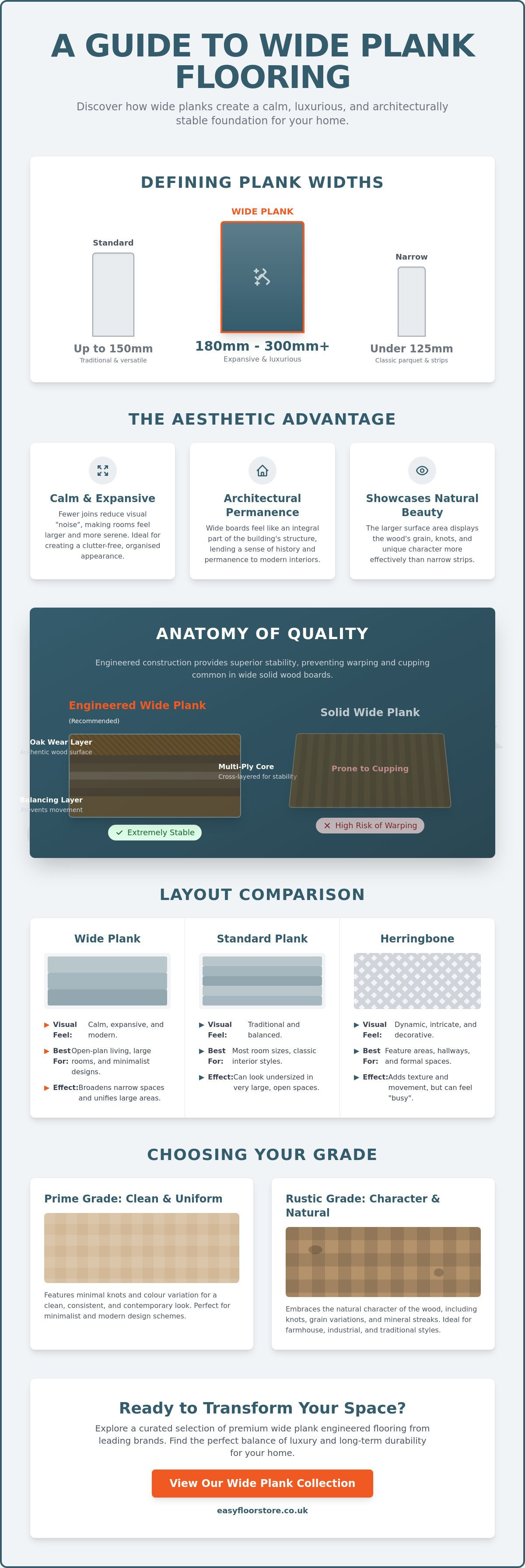
In the UK flooring market, "wide" isn't a vague descriptor; it refers to boards that typically exceed 180mm in width, with premium options reaching up to 300mm. Choosing wide plank engineered flooring is a deliberate move away from the busy, fragmented appearance of narrow strips. Historically, these expansive boards were the hallmark of stately manor houses, where massive old-growth timbers were used to create floors of immense scale. Today, we recreate that sense of grandeur using modern technology. Whilst solid wood of this width would be prone to significant movement, the core of engineered wood flooring provides the structural integrity needed to support these impressive dimensions without the risk of cupping or gapping.
The secret lies in the Engineered wood flooring construction, which layers timber in opposing directions to counteract natural expansion. This allows homeowners to enjoy the heritage aesthetic of a 240mm oak board with total peace of mind. The psychological impact of these floors shouldn't be underestimated. A floor with hundreds of small joints can feel frantic, whereas a wide plank surface feels grounded and steady. It’s about creating a quiet luxury that doesn't scream for attention but provides a solid, reassuring presence underfoot.
Why Wider Planks are Trending in British Homes
British interiors have shifted dramatically towards open-plan living. When walls come down, the floor becomes the primary canvas that unites a kitchen, dining, and living area. Wide boards are perfect for this because they showcase the natural character and intricate grain of the oak far more effectively than smaller segments. Whether you're leaning into a minimalist Scandinavian look or a warm, rustic farmhouse style, these planks provide a cohesive foundation. They offer a sense of calm that mirrors our desire for more organised, serene living environments. By allowing the natural knots and swirls of the wood to remain intact across a larger surface area, the floor tells a more complete story of the tree's life.
The Aesthetic Benefit of Fewer Seams
One of the most powerful psychological effects of a wide floor is the reduction of visual noise. By minimising the number of vertical seams, the eye is allowed to travel across the room without interruption. This visual continuity is a secret weapon for interior designers looking to balance scale and comfort.
- Broadening narrow spaces: Running wide plank engineered flooring across the width of a narrow room can actually make the space feel broader and less restrictive.
- Architectural permanence: Fewer joins create a "clutter-free" surface that feels more like a permanent architectural feature than a temporary decorative covering.
- Scale and proportion: In larger rooms, standard planks can look undersized; wide boards match the scale of modern architecture and grand renovations.
Anatomy of Quality: How Wide Plank Engineered Floors are Constructed
Understanding how a floor is built is the first step toward long-term satisfaction. Whilst solid wood is often romanticised, it has a physical limit that is hard to ignore. Once a board exceeds 150mm in width, the internal tensions within the timber become incredibly difficult to manage. Solid wide planks are notoriously prone to cupping, a process where the edges of the board lift higher than the centre due to moisture absorption. Wide plank engineered flooring was designed specifically to overcome this architectural hurdle. By using a cross-layered core, the natural desire of the wood to expand and contract is physically restrained, ensuring your floor remains perfectly flat for decades.
The stability of these boards depends heavily on the core construction. Most high-end wide boards utilise either a three-ply or a multi-ply system. Three-ply involves a top layer of oak, a middle core of softwood or hevea, and a balancing back layer. For boards reaching widths of 220mm or more, multi-ply is often the superior choice. This method uses multiple thin layers of birch plywood glued in opposing directions. This lattice-like structure provides immense dimensional stability, which is vital when dealing with the significant surface area of a wide plank. If you're unsure which core type suits your specific subfloor, you can view our curated range of engineered boards to see the technical specifications of each style.
Understanding the Wear Layer and Re-sanding
Longevity is a primary concern for homeowners moving away from solid wood. The wear layer, or lamella, is the top slice of real oak that you see and feel. We recommend aiming for a wear layer between 4mm and 6mm for premium projects. A 6mm wear layer provides enough depth to be professionally re-sanded up to four times. Given that most residential floors only require sanding once every 15 to 20 years, this ensures your investment is just as durable as a traditional solid floor whilst offering far better stability.
Stability in Varying UK Climates
British homes present a unique challenge for timber. We experience high humidity in the autumn and bone-dry heat from central heating during the winter months. This cycle causes wood to "breathe" excessively. Solid wood would likely gap or creak under these conditions, but engineered construction acts as a buffer against these shifts. It is also the only safe choice for installation over underfloor heating. The layered core allows heat to pass through efficiently without drying out the wood to the point of structural failure.
Wide Plank vs. Standard Plank vs. Herringbone: A Layout Comparison
Selecting the right layout is just as vital as choosing the timber species. Whilst the material provides the colour and texture, the layout dictates the room's rhythm. Standard planks, typically ranging from 120mm to 150mm, remain the traditional choice for smaller rooms or period cottages. These narrower boards respect the modest proportions of older architecture without competing for attention. However, for expansive modern renovations, wide plank engineered flooring has become the preferred choice. By using boards that reach 240mm or wider, you create a sense of luxury that narrow strips simply cannot replicate.
One practical advantage of wider boards is the speed of installation. Because each plank covers significantly more surface area, a professional can often fit the floor faster than they could with narrow alternatives. This efficiency reduces the time your home remains a building site. Parquet styles like herringbone offer a decorative alternative, adding a layer of texture and "flow" that wide planks lack. Whilst wide boards lead the eye in a single, calming direction, herringbone creates a more energetic, zig-zag pattern that works beautifully in entryways or feature rooms.
When to Choose Wide Planks over Standard Widths
A helpful rule of thumb is to match the scale of your furniture to the scale of your floor. If you've invested in a large, modular sofa or a grand dining table, standard narrow planks can look busy and undersized beneath them. Wide planks provide a stable visual anchor for large-scale pieces. They are particularly effective in light-filled extensions where the natural light can stretch across the full width of the board, highlighting the grain without the interruption of frequent joins. From a budget perspective, expect the price-per-metre for wide boards to be higher; larger cuts of high-quality oak are rarer and require more careful selection at the mill.
Wide Plank vs. Herringbone: Traditional vs. Contemporary
The choice between wide plank engineered flooring and a patterned layout often comes down to the architectural bones of your home. Victorian properties with high ceilings and intricate cornicing frequently suit the geometric complexity of parquet. If you love the look but need a more budget-friendly or moisture-resistant option for a utility space, herringbone laminate flooring provides a similar visual energy with added durability. In contrast, modern industrial aesthetics or minimalist designs benefit from the long, clean lines of wide planks. These boards draw the eye towards a view or a focal point, such as a fireplace or a garden window, creating a direct visual path that feels intentional and serene.
Choosing the Right Grade and Finish for Your Space
Once you've decided on a wide format, the next step is selecting a grade and finish that aligns with your daily life. The grade of the wood refers to its visual character, specifically the frequency of knots and colour variations. For a minimalist, gallery-like feel, Prime grade offers a clean, uniform appearance that emphasises the sheer scale of the board without distraction. Conversely, Rustic grade celebrates the oak’s history, featuring larger knots and more dramatic grain patterns. These natural "imperfections" are often more striking on wide plank engineered flooring because the increased surface area allows the wood’s story to unfold across the room.
Many homeowners worry about whether a board can be "too wide" for their space. As a general rule of thumb, you should aim to fit at least three full-width boards across the narrowest part of a room. If you can only fit two, the floor may look disproportionate and lose its architectural impact. To define these individual planks, we almost always recommend a bevelled edge. A small "V-groove" between boards ensures that each plank is distinct, preventing the floor from looking like a flat, characterless sheet of plywood. You can explore our full range of grades and finishes to find the perfect match for your home’s proportions.
Rustic vs. Select Grades: Finding Your Style
Rustic grades are particularly popular in the UK for wide formats because they create a "reclaimed" or natural look that feels established from day one. In wider boards, knots and splits are carefully managed during production. Any large voids are filled with a high-strength resin that matches the wood’s tone, ensuring the board remains structurally sound whilst retaining its rugged charm. If your goal is a contemporary, sleek aesthetic, Select or Prime grades provide a more organised, sophisticated backdrop that lets your furniture and art take centre stage.
UV Oiled vs. Matt Lacquered Finishes
The finish you choose dictates how your floor will age and how much effort you'll spend on upkeep. Matt Lacquer is often the best choice for high-traffic kitchens or homes with pets, as it creates a hard-wearing barrier against spillages and stains. However, for a truly natural feel, UV Oil is the preferred specialist choice. Whilst it requires slightly more regular care, it allows for spot-repairs; you can fix a small scratch in one area without having to sand the entire room. To hide the inevitable scuffs of a busy household, consider a brushed finish. This process removes the softer summerwood from the surface, leaving a textured grain that is far more forgiving than a smooth, sanded board.
Sourcing Premium Wide Plank Flooring with Easy Floor Store
Sourcing the perfect floor is about more than just finding a colour you like; it’s about ensuring the technical specifications match your home’s environment. At Easy Floor Store, we act as a bridge between high-end manufacturing and your renovation project. Our collection of wide plank engineered flooring is the result of rigorous curation. We understand that wide boards carry a higher risk if the construction is subpar, which is why we only stock products with proven stability. By focusing on industry-leading brands, we help you avoid common pitfalls like delamination or excessive movement that can plague lower-quality wide boards.
Our partnerships with Ted Todd and Woodpecker Flooring allow us to offer an unparalleled range of textures and finishes. We don't just provide a catalogue; we provide a filtered selection of the best timber available in the UK today. Whether you are looking for a specific reclaimed aesthetic or a sleek, modern finish, our centre coordinates national delivery to ensure your premium boards arrive safely at your door, regardless of where your project is located. This logistical expertise ensures that even the most delicate, wide-format timbers reach you in pristine condition.
The Ted Todd and Woodpecker Difference
Ted Todd Wood Flooring is renowned for its commitment to British design, often pushing the boundaries of surface textures and wood tones. Their wide planks are a favourite amongst architects for their unique character and architectural scale. Woodpecker Flooring, on the other hand, has built a stellar reputation for durability and ethical, sustainable sourcing. Both brands have mastered the art of creating wide boards that are fully compatible with underfloor heating. This ensures that your luxury floor remains stable and beautiful even as temperatures fluctuate throughout the British seasons.
Expert Advice for Your National Project
Every home has different lighting conditions, which can dramatically change how wide plank engineered flooring appears in your space. We encourage you to use our sample service to see how the grain and grade interact with your specific interior light. We operate on a supply-only basis, which allows us to focus entirely on product quality and competitive pricing. This model ensures you get the best possible value for premium materials without the overheads associated with full-service firms. If you need guidance on board widths, grade selection, or technical suitability, contact our specialists for a tailored consultation that puts your project's success first.
Elevate Your Interior with Lasting Confidence
Investing in wide plank engineered flooring is a transformative choice that brings architectural scale and a sense of calm to your home. You now understand that the secret to a successful wide-board installation lies in the technical multi-ply construction that prevents warping, coupled with a layout that respects the proportions of your room. Whether you choose the rugged character of a rustic grade or the sleek uniformity of a prime finish, the result is a floor that feels intentional and permanent.
As an authorised retailer for world-class brands like Ted Todd and Woodpecker, we provide the expert technical support needed to ensure your national project runs smoothly. Our specialist UK-wide distribution network ensures your premium timber arrives in perfect condition, ready to be the foundation of your space for decades. We take pride in our curated selection, ensuring every board we stock meets the highest standards of stability and aesthetic excellence.
Browse our full range of premium Wide Plank Engineered Flooring today. We look forward to helping you find a floor that perfectly balances luxury with everyday durability.
Frequently Asked Questions
Will wide plank flooring make a small room look smaller?
Wide planks actually make a small room feel larger by reducing the number of joins that break up the floor surface. When you have fewer vertical lines, the eye perceives a more continuous, open area. This creates a calmer environment that feels significantly less cluttered than a room filled with narrow strips.
Is wide plank engineered flooring suitable for underfloor heating?
Yes, wide plank engineered flooring is perfectly compatible with underfloor heating due to its layered, cross-grain construction. Unlike solid wood, which would likely dry out and warp, the engineered core allows heat to transfer efficiently whilst maintaining structural integrity. It's essential to follow the manufacturer's temperature guidelines to ensure the oak wear layer remains stable.
What is the most stable width for engineered wood flooring in the UK?
A width of 190mm is widely considered the "sweet spot" for stability in the UK’s fluctuating humidity levels. Whilst multi-ply boards can safely reach 300mm, the 180mm to 190mm range offers a classic wide-plank aesthetic with minimal risk of movement. Boards of this width provide an excellent balance between architectural scale and long-term performance in British homes.
Do wide planks cost more to install than standard planks?
Wide planks are often faster to fit because each board covers a larger surface area, which can reduce the time your installer spends on-site. Whilst the material cost per square metre is typically higher for wider cuts of oak, the labour cost for installation is often comparable to standard planks. You'll find that the efficiency of laying fewer boards can lead to a quicker, more seamless project completion.
How do I prevent gaps between wide engineered wood planks?
Preventing gaps starts with proper acclimatisation of the boards in the room where they'll be installed for at least 48 to 72 hours. We also recommend a glue-down installation method for wide boards. This provides a more rigid, permanent bond to the subfloor, which significantly reduces the natural movement that causes gapping during seasonal humidity shifts.
What is the difference between a 190mm and a 240mm wide plank?
The primary difference is the visual scale and the number of joins visible across the floor. A 190mm board is a versatile choice that suits most standard British rooms, whereas a 240mm plank is a premium, statement-making width designed for expansive, open-plan spaces. Choosing the 240mm option will result in fewer joins per square metre, creating an even more unified and luxurious appearance.
Can wide plank engineered flooring be installed as a floating floor?
You can install wide plank engineered flooring as a floating floor using an underlay, but it isn't always the best approach for very wide boards. For planks exceeding 200mm, a glue-down method is often preferred by specialists. This ensures the floor feels solid underfoot and eliminates the "bounce" or hollow sound sometimes associated with floating installations.
How do I maintain a wide plank floor to prevent it from looking dull?
Regular maintenance involves using a pH-neutral wood cleaner and avoiding excessive water, which can damage the timber over time. If your floor has a UV-oiled finish, applying a maintenance oil once every year or two will nourish the oak and restore its natural lustre. Avoid using generic supermarket floor cleaners; these often contain waxes or chemicals that leave a dulling residue on the surface.