



Why would a discerning homeowner choose a more intensive installation method when "quick-fix" click-fit options seem so accessible? It's a question we hear often, yet the answer lies in the uncompromising stability that only a permanent bond can provide. You've likely felt the frustration of floors that creak or noticed the unsightly gapping that occurs when floating planks shift over time. You want a foundation that feels as solid as it looks, reflecting the care you've put into your home's interior.
In this guide, you'll discover why glue down LVT flooring is the premier choice for achieving high-end, bespoke designs like herringbone or ultra-wide planks whilst ensuring they stay perfectly in place for decades. We'll demystify the professional standards for subfloor preparation, such as ASTM F710, and explain how to select the right adhesives to ensure your investment stands the test of time. From understanding the shift towards warm, matte tones to mastering the technical specifications of a 20 mil wear layer, we're here to help you create a quiet, beautiful space that truly lasts.
Key Takeaways
- Learn why the high-density profile of dry-back tiles provides superior acoustic performance and eliminates the need for unsightly expansion gaps at your room's edges.
- Discover how glue down LVT flooring enables total design freedom, allowing you to create complex, bespoke patterns that remain perfectly stable for decades.
- Understand the critical role of subfloor preparation and why professional smoothing compounds are non-negotiable for achieving a flat, permanent finish.
- Compare the total lifetime value and maintenance requirements of permanent installations versus floating floors to make a confident, long-term investment.
- Find out how to curate your space using premium samples from specialist brands like Ted Todd and Woodpecker to ensure a perfect match with your home's unique light and colour palette.
What is Glue Down LVT Flooring and Why is it the Professional’s Choice?
Glue down LVT flooring, frequently referred to in the industry as 'dry back' flooring, represents the pinnacle of permanent floor coverings for the modern home. Unlike click-system alternatives that rely on interlocking joints, these tiles are bonded directly to a prepared subfloor using high-strength adhesives. This method of installation creates a floor that is physically integrated into the building's structure. It draws its heritage from the durable Vinyl composition tile used in high-traffic commercial settings, yet modern luxury vinyl has evolved to offer the breathtaking textures of natural oak and stone.
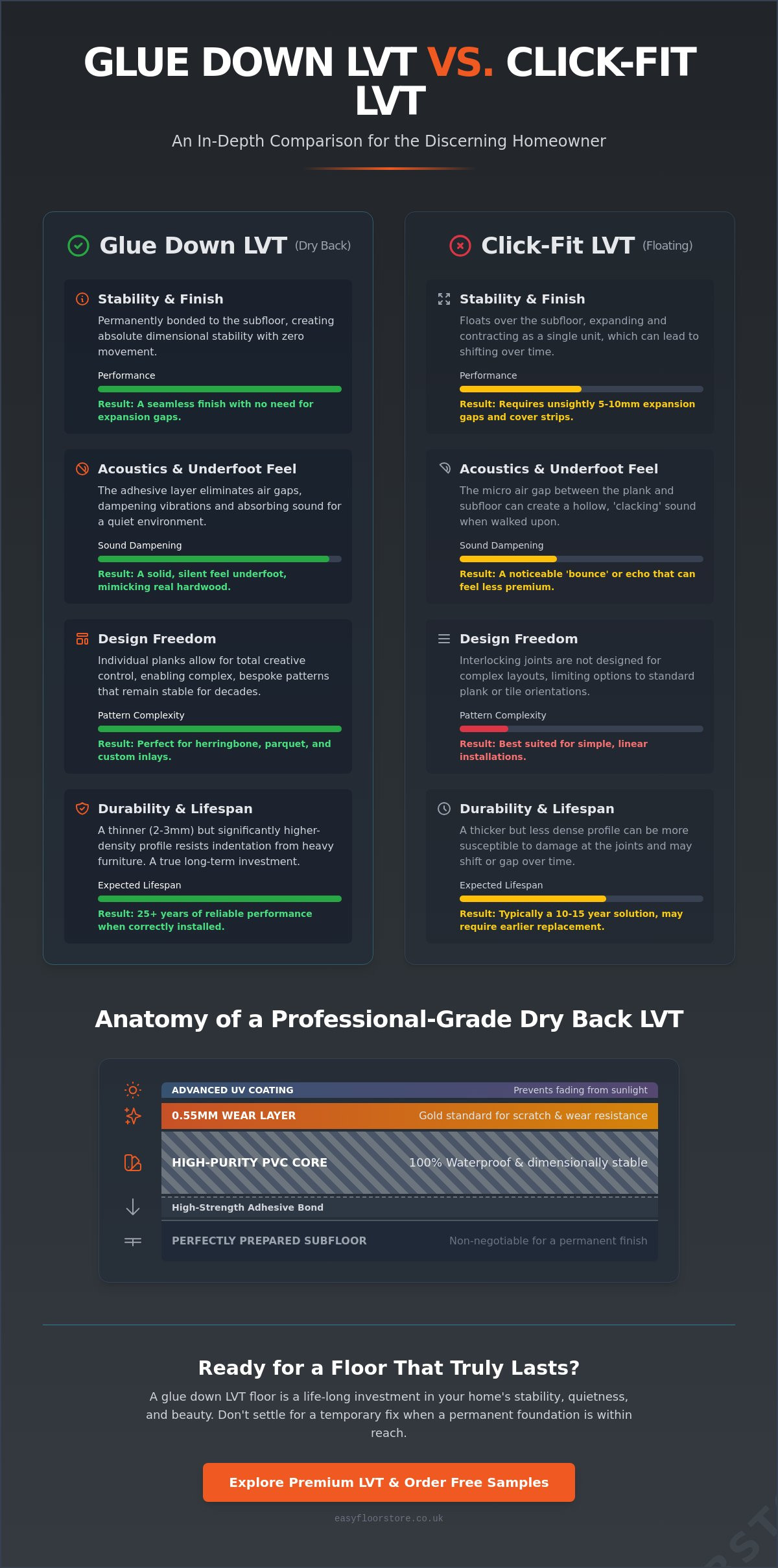
Professional fitters almost always recommend this approach for expansive, open-plan living areas. One of the greatest frustrations with floating floors is the requirement for expansion gaps around every perimeter and doorway. Because glue-down planks are fixed in place, they don't expand and contract as a single raft. This allows for a seamless finish against skirting boards and transitions between rooms without the need for bulky cover strips. Whilst the profile is typically thinner than click variants, ranging from 2mm to 3mm, the density is significantly higher, providing a more robust surface that resists indentation from heavy furniture.
The Anatomy of a Dry Back Tile
Quality is defined by the wear layer. In a professional-grade tile, a 0.55mm wear layer is the gold standard, providing a formidable barrier against scratches and daily wear. Beneath this, a high-purity PVC core provides the necessary flexibility to follow the contours of a perfectly smoothed subfloor whilst remaining completely waterproof. To protect your investment, these tiles feature advanced UV coatings. These layers are vital for south-facing British lounges, as they prevent the vibrant colours and intricate wood grains from fading under prolonged exposure to natural light.
Glue Down vs Floating Floors: The Core Philosophy
The fundamental difference lies in how the floor feels underfoot. Floating floors often exhibit a slight 'bounce' or hollow sound when walked upon, which can detract from the premium feel of a home. A bonded floor eliminates this entirely, offering a solid, silent experience that mimics real hardwood. It's a life-long investment rather than a temporary fix. When correctly installed, glue down LVT flooring is easily a 25-year solution, providing a level of structural integrity that simply cannot be matched by systems that merely sit on top of the subfloor.
The Technical Advantages: Stability, Sound, and Bespoke Design
Choosing a floor involves more than just picking a pattern; it's about how that surface interacts with your home's architecture. One of the most significant benefits of glue down LVT flooring is its unrivalled dimensional stability. Because every plank is bonded to the subfloor, the material cannot move as a single unit. This eliminates the need for the 5-10mm expansion gaps typically required around the perimeter of click-fit floors. You can run your flooring right up to the skirting boards or kitchen plinths for a crisp, professional finish that looks integrated rather than "dropped in."
This stability is backed by rigorous testing. High-quality LVT products are manufactured to meet ASTM resilient floor covering standards, ensuring they possess the mechanical strength to resist curling and lifting. In large, open-plan British homes where temperature fluctuations from underfloor heating or large glass bifold doors are common, this permanent bond prevents the floor from buckling or gapping over time. It's a level of reliability that floating floors simply can't promise.
Acoustics and the 'Solid' Underfoot Feel
The science of sound in a home often comes down to air gaps. Click-fit floors, even with high-quality underlay, inherently have a microscopic pocket of air between the plank and the subfloor. This creates the "clacking" sound often associated with laminate. With a glue-down installation, the adhesive layer acts as a continuous vibration dampener. By removing the air gap, you transform the acoustic profile of the room. Footsteps sound muffled and solid, creating a premium atmosphere in hallways and bedrooms where peace and quiet are priorities. If you're planning a layout that requires this level of precision, you can explore our full luxury vinyl tile collection to find the perfect texture for your project.
Bespoke Layouts: Beyond the Standard Plank
Design freedom is perhaps the most exciting reason to choose a bonded floor. Since you aren't restricted by the interlocking "tongue and groove" mechanism of a click system, you can orient planks in any direction. This allows for the creation of intricate herringbone and chevron patterns that remain perfectly aligned for decades. You can also incorporate:
- Feature Strips: Use thin strips between planks to mimic the look of traditional grouting or to add a metallic accent.
- Decorative Borders: Frame your room with a contrasting border to define dining or seating areas.
- Material Mixing: Seamlessly transition from a wood-effect plank to a stone-effect tile in the same room without needing a transition strip, as both products sit at the same height.
Glue Down vs Click LVT: A Comprehensive Comparison
Choosing between installation methods often feels like a trade-off between immediate convenience and long-term performance. Click-fit systems have gained popularity for their "click-and-go" simplicity, making them a favourite for quick weekend renovations. However, for a home designed to last decades, the comparison shifts in favour of a permanent bond. Whilst a click floor is faster to lay, it remains a "floating" surface that is susceptible to movement. In contrast, glue down LVT flooring offers a level of structural integrity that simplifies long-term maintenance, especially in high-traffic areas like bustling family kitchens or hallways.
In commercial environments, where floors must endure heavy footfall and rolling loads, glue-down is the undisputed standard. This isn't just about durability; it's about safety and consistency. Because the tiles are fixed, there's no risk of the floor shifting or the locking mechanisms failing under pressure. This commercial-grade reliability is what homeowners are now bringing into their own spaces to ensure their flooring remains as pristine on year twenty as it was on day one.
The Maintenance and Repair Advantage
One of the most misunderstood aspects of flooring is what happens when life's accidents occur. If a heavy object is dropped and damages a click-fit plank in the centre of your room, the repair is often an invasive process. You frequently have to uplift every plank from the nearest wall just to reach the damaged section. With glue down LVT flooring, you can perform a "surgical" replacement. A professional can heat the specific damaged tile to soften the adhesive, lift it out, and bond a new one into the exact same spot. This process takes minutes rather than hours and leaves the rest of your floor entirely undisturbed.
Total Cost of Ownership
When evaluating the investment, it's vital to look beyond the price per square metre of the product alone. Glue-down tiles are typically less expensive to purchase than their click-fit counterparts because they don't require the complex integrated locking joints. However, you must factor in the cost of high-quality adhesives and the necessary subfloor preparation. We recommend looking for products that meet the standards set by the Resilient Floor Covering Institute (RFCI), which ensures the materials are tested for safety and performance.
The true value of a bonded floor lies in its lifespan. Whilst a floating floor might need replacing if the joints fail or the subfloor shifts, a glue-down installation is a permanent fixture. It adds tangible value to a property by providing a floor that doesn't creak, move, or require expansion strips between rooms. It's the difference between a temporary surface and a fundamental part of your home's architecture.
Essential Subfloor Preparation and Room Suitability
The success of your new floor depends entirely on what lies beneath it. In the flooring industry, we live by a "Golden Rule": your finish is only as good as your foundation. Whilst click-fit systems can sometimes bridge minor imperfections, glue down LVT flooring is far less forgiving. Because the tiles are thinner and bonded directly to the surface, they will "telegraph" every bump, pit, or grain of sand through to the finished surface. Achieving a professional result requires a subfloor that is clean, dry, and perfectly smooth.
Moisture is the most common cause of adhesive failure in British homes, particularly in new builds or ground-floor renovations. Before any bonding begins, the subfloor must be tested for moisture levels. For concrete bases, we adhere to the ASTM F710 standard, ensuring the slab is dry and free of contaminants. In the UK, this typically means a Relative Humidity (RH) reading of below 75%. If your readings are higher, a damp-proof membrane (DPM) becomes a non-negotiable part of the installation process to prevent the adhesive from emulsifying over time.
Preparing Concrete and Timber Subfloors
Timber floors require a specific approach to ensure a rigid base. You cannot glue LVT directly to floorboards, as the natural movement of the wood will cause the tiles to lift. Instead, the floor must be over-boarded with 6mm flooring-grade plywood, such as SP101. This creates a stable, flat canvas. For concrete subfloors, a high-quality self-levelling or smoothing compound is essential. This liquid screed fills in the dips and removes ridges, creating a surface that feels like glass. Once dry, priming the surface ensures the adhesive creates a permanent, iron-clad bond with the tile.
LVT and Underfloor Heating (UFH)
Glue-down tiles are the most efficient partners for underfloor heating systems. Because the tiles are bonded directly to the screed, there is no air gap to act as an insulator. This results in a much lower thermal resistance (R-Value) compared to floating floors, allowing heat to transfer into your room faster and more consistently. It's a remarkably effective way to reduce energy waste whilst maintaining a comfortable home.
To protect the floor's integrity, you must use a high-temperature adhesive specifically designed for UFH environments. It's also vital to "commission" your heating correctly. This involves gradually increasing the temperature over several days before and after the installation to allow the subfloor and adhesive to settle. If you're ready to start your project, you can browse our full LVT collection to find a style that suits your home's heating requirements.
Selecting Your Perfect Floor: Premium LVT at Easy Floor Store
Choosing the right floor is a significant decision, and we believe it should be a rewarding one. At Easy Floor Store, we've moved beyond the overwhelming "everything-at-once" approach to offer a curated selection of glue down LVT flooring that meets our rigorous standards for both aesthetics and durability. Our partnership with prestigious British brands like Woodpecker and Ted Todd ensures you have access to the finest designs, from rustic oaks to contemporary stone effects, all backed by industry-leading warranties.
Our team understands the nuances of national UK distribution and technical support. We don't just supply boxes; we provide a logistics network that ensures your materials arrive safely and promptly, whether you're renovating a city dwelling or a rural cottage. This commitment to service is why we've become a trusted partner for homeowners seeking more than just a transactional purchase. We treat every project with the same level of care you do, acting as a steady hand through the selection process.
Expert Curation for British Interiors
We pay close attention to how our LVT ranges complement our engineered wood flooring collections. This allows you to maintain a cohesive design language throughout your home, perhaps using real wood in the lounge whilst opting for a matching LVT in the kitchen or utility room. By selecting specific wear layers for different zones, we help you balance performance with budget. A hallway might require the maximum protection of a 0.55mm layer, whilst a guest bedroom can achieve the same aesthetic with a slightly different specification. Our expertise ensures your investment is precisely tailored to your lifestyle.
Ready to Transform Your Space?
Before you commit, we encourage you to use our sample service. Seeing a tile amongst your own furniture and under your home's unique lighting is essential for making a confident choice. Once you've found your favourite shade, our specialists can help you calculate your metreage, including the necessary wastage for intricate patterns like herringbone, which typically requires an additional 10 percent. We'll also help you identify the correct adhesive to ensure your floor remains a permanent fixture for years to come.
Navigating our online store is designed to be intuitive. You can filter by shade, thickness, and brand to find exactly what you need. If you're ready to take the next step, you can Explore our full Glue Down LVT collection today and start the journey toward a more beautiful, stable home.
Invest in a Foundation of Permanent Style
Choosing your home's foundation is a significant commitment to both aesthetics and long-term peace of mind. By opting for glue down LVT flooring, you are moving beyond temporary trends and investing in a surface that offers unrivalled stability, superior acoustics, and the freedom to create bespoke patterns. A high-performance 0.55mm wear layer ensures your floor remains resilient against the demands of daily life, whilst the lack of expansion gaps provides a seamless finish that floating floors simply cannot replicate.
As specialist suppliers of industry-leading brands such as Ted Todd and Woodpecker, we provide expert technical advice for national UK projects. We help you navigate every technicality, from subfloor moisture testing to selecting the perfect adhesive for your specific environment. We believe that a beautiful home starts from the ground up, and we are here to support you at every stage of that journey. Browse our premium Glue Down LVT ranges and order your samples today to experience this quality firsthand. We look forward to helping you create a space that truly lasts.
Frequently Asked Questions
Is glue down LVT better than click LVT for kitchens and bathrooms?
Glue-down is widely considered superior for wet areas like kitchens and bathrooms. Because the tiles are fully bonded to the subfloor, there's no risk of water seeping through joints and sitting beneath the floor, which can happen with floating systems. This permanent seal prevents the growth of mould and ensures the floor remains hygienic and stable even in high-moisture environments where spills are frequent.
Can I install glue down LVT flooring myself or do I need a professional?
We strongly recommend using a professional installer for glue down LVT flooring. Whilst the tiles themselves are easy to handle, the success of the project relies on meticulous subfloor preparation, including moisture testing and applying smoothing compounds. A professional ensures the adhesive is applied correctly and the patterns are aligned perfectly, protecting your long-term investment and ensuring the product warranty remains valid throughout its lifespan.
How long does glue down LVT need to 'set' before I can walk on it?
You should typically wait at least 24 hours before walking on the floor and 48 hours before moving heavy furniture back into the room. This allows the adhesive to fully cure and create a permanent bond with the subfloor. It's vital to follow the specific instructions provided by the adhesive manufacturer, as temperature and humidity levels in your home can slightly affect these curing times.
Do I need underlay for glue down luxury vinyl tile flooring?
No, you don't use traditional underlay with glue-down tiles. These tiles are designed to be bonded directly to a prepared subfloor or smoothing compound. Using an underlay would prevent the adhesive from creating a secure bond, leading to shifting or lifting. The acoustic benefits and solid feel are instead achieved through the direct contact between the high-density tile and the structurally sound subfloor.
Is glue down LVT compatible with electric and water-based underfloor heating?
Yes, it's exceptionally compatible with both electric and water-based underfloor heating. Because glue down LVT flooring is thinner and bonded directly to the screed, it transfers heat much more efficiently than floating floors. It's essential to use a high-temperature adhesive and ensure the heating system is commissioned correctly, gradually increasing the temperature both before and after the installation process to prevent thermal shock.
How do I clean and maintain a glue down vinyl floor to ensure it lasts?
Maintenance is straightforward and involves regular sweeping or vacuuming with a soft brush attachment to remove grit. For deeper cleans, use a damp mop with a pH-neutral cleaner specifically designed for luxury vinyl. You should avoid using steam mops or abrasive chemicals, as these can damage the protective wear layer and weaken the adhesive bond, potentially causing the edges of the tiles to lift.
Can glue down LVT be installed over existing tiles or floorboards?
It shouldn't be installed directly over existing tiles or floorboards without proper preparation. For timber floors, you must install 6mm flooring-grade plywood first to create a rigid, stable base. For existing ceramic tiles, a smoothing compound is usually applied over the top to fill in grout lines and create a perfectly flat surface, ensuring the new adhesive has a consistent surface to grip.
What happens if a glue down LVT tile gets damaged?
Damaged tiles can be replaced individually without disturbing the rest of the floor. A professional can carefully heat the specific damaged tile to soften the adhesive, lift it out, and bond a fresh tile in its place. This "surgical" repair is a major advantage over click-fit systems, which often require uplifting large sections of the floor from the nearest wall just to reach one damaged plank.