



True waterproof performance is defined by core density and joint integrity, not just a pretty vinyl surface. You likely want the elegant aesthetic of natural oak or stone but feel hesitant about the practicalities of moisture and maintenance in a busy UK household. It's a common concern. Most homeowners worry that even high-end finishes might eventually lift, feel cold, or sound "clicky" underfoot. We believe you shouldn't have to compromise between sophisticated style and everyday survival.
This guide helps you master the selection of waterproof LVT flooring by explaining the core technologies and installation methods that define long-term performance. You'll learn the vital differences between SPC and WPC rigid cores, which now represent over 58% of the market. We also cover the essential British Standard BS 8203 requirements and moisture testing protocols that ensure your new floor remains a stable, beautiful investment for your home's future.
Key Takeaways
- Understand the structural differences between SPC and WPC cores to select the most stable foundation for your specific room environment.
- Discover why modern waterproof LVT flooring offers superior protection against humidity and spills compared to traditional laminate or solid wood.
- Evaluate the performance of Click-Lock versus Glue-Down installation methods to ensure your floor handles subfloor movement and heavy appliances.
- Identify the importance of R10 slip-resistance ratings and proper perimeter sealing for maintaining safety and longevity in bathrooms and utility rooms.
- Learn how to source premium collections from trusted names like Ted Todd and Woodpecker to achieve a high-end aesthetic without compromising on durability.
The Evolution of Waterproof LVT Flooring in Modern British Homes
The British home has undergone a radical architectural transformation. We've moved away from compartmentalised, separate rooms toward expansive, open-plan living areas that demand a single, cohesive floor. This shift created a significant dilemma: how do you find a surface that provides the warmth of timber for the lounge whilst surviving the inevitable spills of a busy kitchen? This is where waterproof LVT flooring has stepped in to bridge the gap. Unlike its predecessors, modern LVT doesn't just resist moisture; it's engineered to be entirely impervious to it.
Historically, homeowners relied on vinyl composition tile for purely functional spaces, but today's luxury vinyl tile (LVT) is a different beast entirely. By 2026, the UK market has moved decisively away from vague "water-resistant" claims toward "100% waterproof" guarantees. This isn't just clever marketing. It's a result of advanced core technologies that ensure the planks remain dimensionally stable even when submerged, making them the gold standard for contemporary renovations.
Why Water Resistance is No Longer Enough
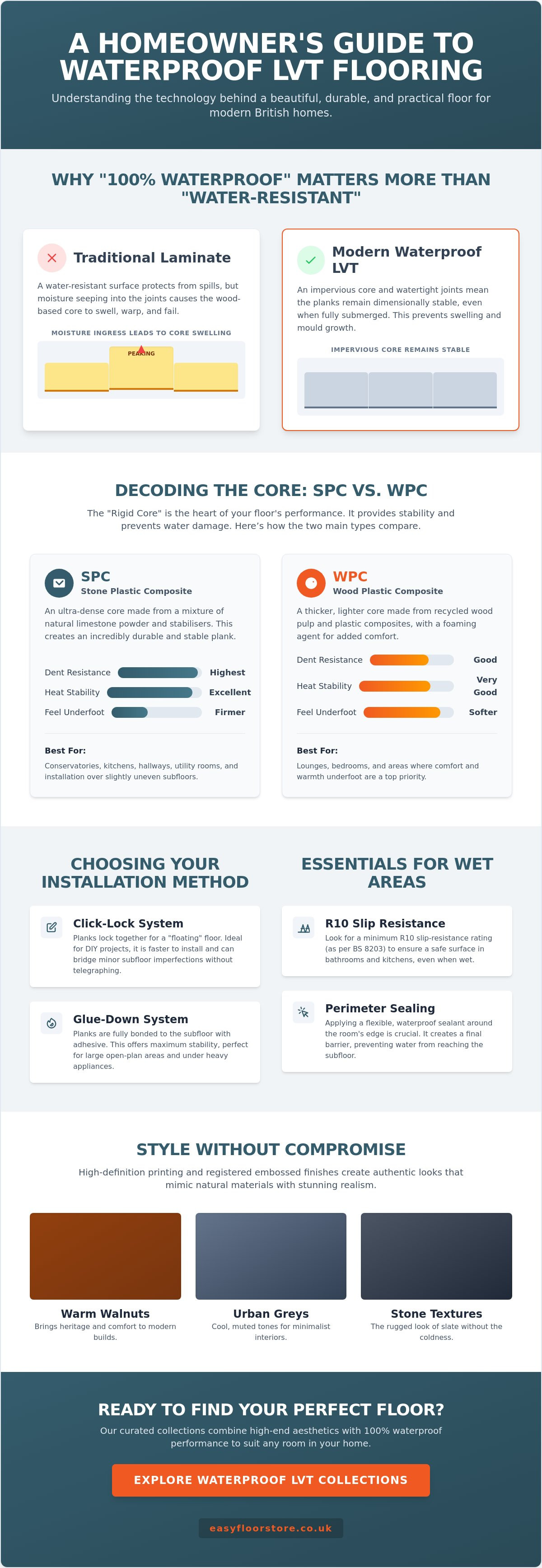
Surface protection only tells half the story. Traditional laminates often feature a water-resistant top layer, but if moisture seeps into the joints, the wood-based core swells and warps. This leads to "peaking" at the seams and eventual joint failure. For UK utility rooms or "mudrooms" where damp coats and wet dogs are the norm, this structural vulnerability is a deal-breaker. True waterproof LVT flooring prevents moisture ingress entirely, eliminating the risk of mould growth beneath the surface. It's a reliable choice for areas where humidity fluctuates, providing peace of mind that your investment won't buckle under pressure.
Aesthetic Versatility: From Oak Effects to Stone Textures
You no longer have to sacrifice beauty for durability. Modern manufacturing uses high-definition print layers that replicate the intricate grains of premium brands like Woodpecker or Ted Todd with startling accuracy. It's about more than just the look. The best products now feature registered embossed finishes. This technology aligns the texture of the wear layer with the visual pattern of the wood grain, creating a floor that feels authentic underfoot. Our curated collections reflect the leading trends for 2026:
- Warm Walnuts: These bring a sense of heritage and comfort to modern builds, moving away from the starker tones of previous years.
- Urban Greys: Muted, cool tones remain a staple for minimalist, industrial-inspired interiors across the UK.
- Stone Textures: From slate to limestone effects, these provide the rugged look of natural stone without the coldness or the need for specialist sealing.
By selecting a floor that combines these high-end aesthetics with a waterproof core, you're investing in a home that looks sophisticated but remains effortlessly practical for a busy household.
Decoding Waterproof Technology: SPC vs WPC vs Rigid Core
Choosing the right waterproof LVT flooring requires looking beneath the decorative surface. While every plank might look like authentic wood or stone, the internal chemistry determines how it handles your home's unique environment. Most modern luxury vinyl falls under the "Rigid Core" category. This technology provides a click-lock system that remains incredibly stable, preventing the gaps that often lead to water damage in traditional floors. According to the World Floor Covering Association guide to vinyl flooring, the moisture resistance of these materials is what makes them so versatile for modern living.
One major advantage of Rigid Core is its ability to "bridge" minor imperfections in your subfloor. If your floor isn't perfectly level, standard flexible vinyl will "telegraph" every bump and dip through to the surface. Rigid core technology stays flat and firm, often saving you significant time and effort on subfloor preparation. It's a structural solution as much as a stylistic one.
The wear layer sits on top, protecting the design from scratches and topical water. However, it's the core density that manages heat. In UK conservatories, where temperatures can soar in summer and plummet in winter, a dense core is vital. It prevents the dramatic expansion and contraction that causes lesser floors to buckle. If you're still debating which core suits your lifestyle, you can browse our curated LVT collections to see the technical specifications of each range.
SPC (Stone Plastic Composite): The Ultimate in Durability
SPC is the heavyweight champion of the flooring world. It's composed of natural limestone powder, polyvinyl chloride, and stabilisers. This creates an incredibly dense, stone-hard core that won't dent under the weight of a heavy mahogany dining table or a large kitchen island. It's ultra-thin, which is helpful when you're trying to avoid trimming doors. The trade-off is that it can feel slightly harder and colder underfoot. We recommend choosing a range with an integrated underlay to add a touch of warmth and sound reduction.
WPC (Wood Plastic Composite): Comfort and Insulation
WPC takes a different approach by blending recycled wood pulp with foaming agents. This creates microscopic air pockets within the core, making the floor feel significantly softer and warmer. It's the ideal choice for bedrooms or lounges where you want that cosy feel without sacrificing waterproof performance. WPC provides excellent sound insulation, which is a bonus for multi-storey homes. While it's slightly more prone to deep indentations from very heavy furniture compared to SPC, it remains a robust and comfortable option for most domestic settings.
Click-Lock vs Glue-Down: Which Waterproof Method Suits Your Project?
Deciding between click-lock and glue-down is a pivotal step in your renovation journey. While both options provide excellent waterproof LVT flooring performance, the installation method impacts everything from the project's timeline to how the floor behaves under your feet. The Resilient Floor Covering Institute notes that proper installation is the foundation of product longevity, especially when managing moisture. Choosing the right method depends on your subfloor condition, the room's purpose, and whether you're tackling the project yourself or hiring a specialist.
The structural integrity of the joints is what truly defines a floor's success in wet environments. In a bathroom or kitchen, you need a seal that prevents water from reaching the subfloor. Both methods achieve this, but they do so through different mechanical principles. One offers flexibility and speed, whilst the other provides a permanent, immovable bond.
The Advantages of Click-Lock LVT
For many UK homeowners, the "floating floor" concept is the most appealing. Click-lock planks snap together without the need for messy adhesives, making Click LVT flooring a favourite for rapid home upgrades and DIY enthusiasts. These systems are designed with precision-engineered joints that create a tight, water-resistant seal. Because the floor isn't bonded to the subfloor, it can move slightly as a single unit. This is particularly helpful in older British properties where subfloors might experience minor shifts. Many of these ranges come with integrated underlays, which significantly reduces the "clicky" sound often associated with harder surfaces. It's a clean, efficient, and high-performance solution.
When to Choose Glue-Down LVT
Whilst click systems are fast, professional installers often specify a permanent bond for more demanding environments. Glue-down LVT involves adhering individual tiles directly to a perfectly prepared subfloor. This creates a superior moisture barrier and unmatched stability. It's particularly effective in areas with significant temperature fluctuations, such as rooms with large south-facing bifold doors or conservatories. If a single tile gets damaged by a dropped heavy object, you can simply lift and replace that specific piece rather than dismantling the whole room. For a deeper dive into the technical requirements of this method, consult our Glue Down LVT Flooring: The Professional’s Guide. Click-lock wins on speed, but glue-down offers a level of permanence and repairability that many find reassuring for a long-term investment.
Essential Considerations for Kitchens, Bathrooms, and Utility Rooms
Every room in your home presents a unique set of challenges for your floor. Whilst waterproof LVT flooring is designed to be impervious to moisture, the way it interacts with your environment depends on the specific demands of the space. In a kitchen, the primary concern is often the sheer weight of appliances. An American-style fridge-freezer or a heavy kitchen island exerts significant pressure. This is where the density of an SPC core becomes invaluable, as it resists the indentations that softer materials might suffer under constant load.
Bathrooms require a different focus. Here, safety and perimeter integrity are paramount. We always recommend choosing a product with at least an R10 slip-resistance rating to ensure a firm footing on wet surfaces. Even the most advanced waterproof LVT flooring can be undermined if water is allowed to seep behind the planks. Using a high-quality silicone sealant around the perimeter and behind skirting boards creates a watertight vessel, protecting your subfloor from hidden moisture damage. For utility rooms, the floor must contend with the high-frequency vibrations of washing machines and the occasional chemical spill from laundry detergents. LVT handles these stresses with ease, providing a durable surface that won't crack or discolour.
If you're planning to install underfloor heating (UFH), LVT is arguably the most efficient partner. Its thin profile and high thermal conductivity allow heat to permeate the room quickly and evenly. Unlike thicker materials, it doesn't act as an insulator, ensuring your heating system operates at peak efficiency. You can explore our full range of LVT options to find the perfect match for your home's heating requirements.
Subfloor Preparation: The Secret to a Waterproof Finish
A waterproof surface is only as good as the subfloor beneath it. For concrete subfloors, a Damp Proof Membrane (DPM) is essential to prevent rising damp from affecting the adhesive or the click-lock mechanism. British Standard BS 8203 dictates strict tolerances for subfloor flatness. If your floor isn't perfectly level, use a high-quality levelling compound. A flat surface is critical; even a minor dip can cause Click-Lock joints to flex and eventually fail. Finally, always allow your planks to acclimatise in the room for at least 48 hours. This ensures the material reaches the ambient temperature of your home before fitting begins.
Managing Transitions and Expansion Gaps
It's a common misconception that waterproof floors don't need expansion gaps. Even though the material doesn't absorb water, it still reacts to temperature changes. You must leave a gap around the entire perimeter, which can be neatly hidden with waterproof colour-matched scotia or skirting boards. Many homeowners choose to transition from engineered wood flooring in hallways to LVT in kitchens. Using a proper transition strip ensures a seamless look whilst allowing both materials to move independently as required by their specific structural properties.
Sourcing Premium Waterproof LVT: The Easy Floor Store Advantage
Selecting the right floor is a significant investment in your home's future. At Easy Floor Store, we act as your "Trusted Specialist," curating a collection that prioritises long-term performance over fleeting trends. We specifically select brands like Woodpecker and Ted Todd because they represent the pinnacle of British design and technical engineering. These manufacturers don't just produce beautiful planks; they create systems that withstand the rigours of modern life. By focusing on expert curation, we help you avoid the common DIY pitfalls associated with budget-grade materials that often fail under the pressure of a busy household.
Our approach is built on transparency and accessibility. We provide national distribution across the United Kingdom, ensuring that premium waterproof LVT flooring is available to homeowners from Cornwall to the Highlands. Because we don't offer installation services, we avoid the heavy overheads that traditional high-street showrooms pass on to their customers. This allows us to focus entirely on product quality and technical support, providing you with high-end materials at a more competitive price point. You get the specialist knowledge of a boutique provider with the efficiency of a national distributor.
Sustainability is a core pillar of our 2026 collection. We recognize that a beautiful home should also be a healthy one. We prioritise products that are phthalate-free and carry low-VOC (Volatile Organic Compound) certifications. These standards ensure that your new floor won't off-gas harmful chemicals, making it a safe choice for children and pets. When you choose a floor from our range, you're investing in a product that respects both your indoor environment and the world outside.
Why Quality Brands Matter for Waterproofing
The difference between budget vinyl and premium LVT often lies in the wear layer and the precision of the click-lock joints. Budget options may look identical in a small photo, but they frequently lack the structural density required to prevent water ingress over time. Premium waterproof LVT flooring features a reinforced wear layer that resists micro-scratches where bacteria and moisture can hide. Furthermore, these high-end products often come with a "Lifetime Residential Warranty." This isn't just a marketing claim; it's a guarantee that the floor will remain structurally sound and waterproof for as long as you live in your home. We always encourage you to order samples. It's the only way to truly test the texture, weight, and colour against your own home's natural lighting before making a commitment.
Making Your Final Decision
Before you finalise your purchase, run through this essential checklist: have you chosen the correct core (SPC for impact resistance or WPC for warmth)? Does the installation method (Click-Lock vs Glue-Down) suit your subfloor? Is the wear layer thickness appropriate for the room's traffic levels? If you're still unsure, our Reading-based specialists are available to provide professional, empathetic advice tailored to your specific project. We're here to ensure your transition from browsing to installation is as seamless as the floor itself. Explore our full range of waterproof LVT flooring today and find the foundation your home deserves.
Transform Your Home with Confidence
Selecting the ideal foundation for your home is about matching technical precision with your personal style. You've discovered how the density of a rigid core handles the unique humidity of British kitchens and bathrooms, and why the choice between click-lock and glue-down methods is vital for your project's success. Investing in high-quality waterproof LVT flooring ensures that your living space remains beautiful and functional, regardless of what daily life throws at it.
We're here to support your journey with UK-wide delivery on all orders and a curated selection of specialist brands including Woodpecker and Ted Todd. Whether you're a DIY enthusiast or a trade professional, our team provides the expert technical support required to turn your vision into a reality. Your home deserves a floor that is as resilient as it is elegant.
Browse Our Premium Waterproof LVT Collection
We look forward to helping you find the perfect surface for your next renovation project.
Frequently Asked Questions
Is LVT flooring 100% waterproof?
Modern waterproof LVT flooring is 100% waterproof because its synthetic core, whether SPC or WPC, doesn't absorb moisture or swell. While the planks themselves are impervious to water, it's vital to remember that the subfloor beneath them isn't. You must ensure the perimeter of the room is properly sealed with silicone to prevent standing water from seeping through expansion gaps and reaching the structural floor below.
Can I use waterproof LVT in a wet room?
Most LVT products aren't suitable for the immediate shower area of a wet room where constant standing water is present. While the material is waterproof, the click-lock joints aren't designed to be submerged or subjected to high-pressure water streams for extended periods. It is, however, an ideal solution for the rest of the bathroom or "dry" areas where splashes and high humidity are common.
Does waterproof LVT require a special underlay?
Many rigid core LVT products feature a pre-attached underlay, which simplifies the fitting process and ensures the correct density. If your chosen range doesn't have an integrated layer, you must use a specific high-density LVT underlay rather than standard laminate or carpet versions. Using an underlay that's too soft will allow for too much movement, which eventually causes the precision-engineered joints to fail.
How do I clean and maintain waterproof vinyl floors?
Cleaning is straightforward; simply sweep or vacuum regularly to remove grit, then use a damp mop with a pH-neutral floor cleaner. We recommend avoiding steam mops, as the intense heat can sometimes affect the adhesive or cause unnecessary stress on the core material. A microfibre mop and a dedicated LVT cleaning solution are the most effective tools for maintaining the floor's original lustre and protective wear layer.
Is LVT better than waterproof laminate for a bathroom?
LVT is generally superior to waterproof laminate in high-moisture environments because it contains no wood-based fibres. Even the best waterproof laminates rely on high-density fibreboard (HDF) which, while treated, can still swell if moisture penetrates the joints. Waterproof LVT flooring remains completely stable even in high-humidity rooms like bathrooms and utility rooms, providing a more reliable long-term solution for UK homeowners.
Can I install waterproof LVT over existing floor tiles?
You can install rigid core LVT over existing ceramic or stone tiles provided they are flat, level, and securely bonded to the subfloor. It's essential to check that the grout lines are narrow and flush; deep grout lines should be filled with a levelling compound first. This prevents "telegraphing," where the pattern of the old tiles eventually becomes visible as a ghost-like impression on your new vinyl surface.
Does waterproof LVT feel cold underfoot?
LVT feels significantly warmer than natural stone or ceramic tiles because it doesn't draw heat away from your feet as rapidly. It's a naturally warmer material that adapts to the ambient temperature of your room. For those seeking extra warmth, it's also highly compatible with underfloor heating systems, which efficiently transfer heat through the thin vinyl planks to create a cosy atmosphere during colder months.
How long does waterproof LVT flooring typically last?
A high-quality LVT floor typically lasts between 20 and 30 years in a residential environment, depending on the thickness of the wear layer. Factors such as foot traffic and maintenance routines play a role in its longevity. Many of the specialist brands we curate offer lifetime residential warranties, providing peace of mind that your floor will remain structurally sound and visually appealing for decades to come.